September in Shropshire is a time of plenty! And the highlight is the Ludlow Food Festival.
Ludlow borders Wales and is one of England’s most rural counties. The town hosts its annual food festival at the beginning of autumn and people come from across the area. Everyone joins in to celebrate local and seasonal produce. Besides the pressing of apples for the making of cider, the local meats are a hit and there is a revival of an ancient fruit.
The Forestry Commission
The meat from the local pigs compete with any European meat. Up in the Clee Hills the pigs do very well. But in the Wye Forest local pig farmers are working closely with the Forestry Commission in a symbiotic relationship.
The Commission is struggling to control the bracken that is taking over the forest. They are committed to reverting the areas of conifer back to broadleaf. The bracken just keeps coming and it swamps the natural regeneration. The farmers have agreed to bring their pigs in to graze in the forest. Grazing pigs disturb the ground. This helps get rid of the root structure for the bracken to survive. The pigs don’t tend to take away from the regeneration of the trees. The key factor is not to keep the pigs in the forest for too long at any one time. So, the focus is on finding the right balance.
Win-Win
How does this benefit the farmers? Pigs are happier and stronger. They have to actively find their food in the forest. This means they produce a well-muscled carcass with good, dark meat. The pigs are matured for twelve months, as opposed to the four months in other commercial ventures. The meat thus has time to develop and is far tastier, especially for the making of salamis. It is a win-win situation!
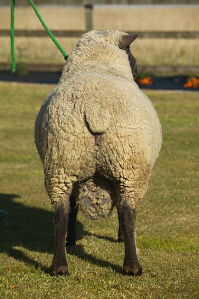
England’s oldest pedigreed sheep
And in other areas of farming, the Shropshire is England’s oldest pedigreed sheep. Breeding them is good commercially as they produce good meat and have a well-known fleece. Almost 50 years ago the Shropshire sheep fell out of favour. Numbers of breeding ewes dropped to below five hundred. The breed was put on the Rare Breed Survival Watch List. But through hard work and determination, the numbers are on a continuous rise.
The sheep are also a great asset for conservation. They are tree-friendly sheep. Other breeds nibble branches and even strip bark off trees. But the Shropshire grazes in plantations of small trees. They are also great to manage the undergrowth. ‘Special Agent’ is a large, handsome sheep who was used locally to breed the Shropshire and his offspring seem to have the tastiest meat.
Prunes!
The Shropshire prune is a local fruit. It is of the damson family and sadly, over the years it too fell out of favour. Part of the problem was that the trees were put into hedges. They were to feed the animals and act as more effective wind-breaks. But the locals are doing what they can to save them.
The fruit looks similar to a sloe of the plum family. It has the same colour just slightly different in shape. In fact the Shropshire prune is a cross between the sloe and the cherry plum. And yet it is not native to Shropshire or even the United Kingdom. The damson originally came from Damascus, hence its name. It is believed that the tree, with its obscure fruit arrived in the country about 2,000 years ago, and possibly by the Romans.
Not many people really know what to do with them. They are flavourful and have a plummy sweetness. A local farmer refers to the fruit as a “plumb with an attitude”. They are great to make syrup for desserts, jam, vinegar, liqueur (wine) and a fruit paste, which is called a cheese. It is not really a cheese, but more of a jam-looking accompaniment to enjoy with dairy cheese or add to a gravy for gamey meats. A local chef has used it to make a ravioli, which was part of the food on offer at the food festival.
The Norman Castle
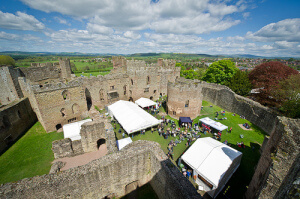
Part of the festival is held in the grounds of the Norman castle, which was built to protect the border from the invaders of the ‘Wild West’, or Wales. Today the only invaders are the tourists. Since 1995, when Ludlow became one of the first towns in Britain to hold a farmers’ market, the revolution began. And the culture of buying food properly and supporting local produce since medieval times has been revived in the annual Ludlow Food Festival.