Maewyn Succat was the man who became Saint Patrick, patron saint of Ireland along with Brigid of Kildare and Columba. Some historians believe he was born in Kilpatrick, Scotland. Others say he was born in Birdoswald in Cumbria. And some even say it may have been Banwen in Wales. Early works have claimed he came from Bannavem Taburniae, but this village name cannot be found on any ancient map of the Great Britain.
We do know that it was the time of Roman rule in Britannia. Patrick’s family was probably of the wealthy upper class and may have already converted to Christianity. Historians are not completely sure when he lived, but it is believed it may have been sometime between 378 and 493.
The Story of St Patrick
The traditional story is that Patrick was taken captive by pirates when he was 16. He was taken to Ireland, where he was sold as a slave. He was enslaved herding sheep and pigs on Slemish Mountain in County Antrim. It is said that during this time he turned to God for comfort. And thus spent much of his time in the mountains in prayer.
Patrick’s Dream
Six years later he had a dream. In this dream he heard Irish voices urging him to escape and pleading with him to return to Ireland. So, he stowed away and made his way back to his family home. He had a deep belief that his awful experience was God’s punishment for not being a believer. And according to his ‘memoires’, (the Confessio) he had another inspirational dream where Victoricus gave him a letter, entitled “The Voice of the Irish.”
On his return to Ireland he decided to follow the professions of his father and grandfather and became a priest.
In the Church
Patrick rose quickly within the church ranks to become a bishop. He returned to Ireland to convert the people to Christianity. But did most of his missionary work in the north and west of the country. It was there where he rose to second bishop of Ireland. His passion led him to build of many churches across the country.
Research & Recorded History
Recent research by historians in Cambridge has shown that Patrick’s father was in fact a Roman tax collector. They believe he found a loop hole in the system to pass his title onto his son. Patrick did not want to be a tax collector and thus fled to Ireland. He then converted to Christianity started his missionary work.
Not much recorded history exists from these by-gone days. The life and work of Patrick has always been a bit hazy. Especially as there has never actually been a link between Patrick and any specific church. What is known from two works written by Patrick, the Confessio and the Letter to Coroticus, is that he baptised thousands of people. And he introduced Christianity to many who lived isolated lives.
Patrick was a Threat
Patrick was a real threat to the pagan chiefs. His life as a missionary was often at risk as he was threatened and imprisoned. Many records can sadly not be confirmed as authentic. Most of what we know about Patrick, we have learnt or deduced from Confessio, which is believed to have been written in the last few years of his life.
Patrick also tried to develop the church structure in Ireland. Although there were changes and developments, the system he and other missionaries worked within was not employed.
What we Believe
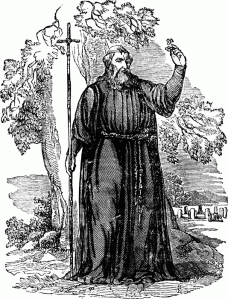
There is of course the legend that Patrick banished snakes from Ireland. He is often shown in art to be trampling on snakes. But research shows that there were no snakes in post-glacial Ireland. There are also suggesitons that snakes were a symbol of the Druids. Snakes were also minted on coins in Gaul at the time. And thus Patrick squashed the Druid religion by converting many of the Irish to Christianity.
Patrick was also possibly the first to teach the concept of the Trinity (the Father, the Son and the Holy Spirit) using the shamrock, a 3-leaved clover to explain the ‘three divine persons in the one God’.
17th March
We believe Saint Patrick died on the 17th March 461AD at Saul, Downpatrick, Ireland. This was where he built his first church. He became the patron saint of Ireland sometime in the 8th century. Again the dates are not clear, but have been widely adopted.
Thus on the 17th March every year, the Irish celebrate the life of Saint Patrick. For hundreds of years, the Irish have attended church on this day and then enjoyed food and drink with family and friends.
The Americans were the first to hold a Saint Patrick’s Day parade in New York City in 1762. But it wasn’t until 1995 that the Irish government decided to push Sanit Patrick’s Day with a global campaign to promote tourism. Since then millions celebrate Saint Patrick’s Day around the world wearing green and drinking Guinness.
Through time, the story of Saint Patrick has evolved. Whatever researchers and historians have unearthed, we can all still appreciate the importance of his ministry in Ireland. And of course make merry every 17th March at local Irish pubs, across the globe, and celebrate the luck of the Irish.
Did you know there was an English Pope?